
Published May 13, 2026
Brickell's Vertical Race: Why 14 Towers Are Rising in One Square Mile of Miami

Brickell's Vertical Race: Why 14 Towers Are Rising in One Square Mile of Miami
If you stood on Brickell Avenue in 2017 and looked up, the tallest thing you'd see was Panorama Tower at 868 feet. It had just become the tallest building south of New York City. People thought that was the ceiling. They were wrong.
Right now, in a roughly one-square-mile section of Miami, fourteen high-rise towers are either under construction, approved, or in active design. Four of them will hit the absolute legal maximum height for any building in the city — 1,049 feet, the FAA's cap due to flight paths from Miami International Airport.
The four supertalls
Cipriani Residences, by Mast Capital, has already topped 872 feet on its way to 950. Designed by Arquitectonica. Penthouses have sold for over $30 million. Opens 2027.
Waldorf Astoria Miami will be Florida's first true supertall — 100 stories, with a stacked-cubes silhouette. By PMG and partners. When it delivers in 2028, it'll be the tallest residential building on the East Coast outside Manhattan.
888 Brickell is Dolce & Gabbana's first US branded residence, developed by JDS Development and designed by Studio Sofield. The penthouse is asking $88 million. Demolition is happening now.
Citadel Tower, at 1201 Brickell Bay Drive, is the most interesting of the four. Ken Griffin's hedge fund is building a $2.5 billion Foster + Partners-designed global headquarters. Last week, Griffin reworked the plans to strip out the hotel and make it pure office — a massive vote of confidence in Brickell as an actual financial center, not just a luxury condo market.
Why it's happening now
Three things converged. First, the tax migration: Florida has no state income tax, and after 2020, finance and tech firms moved south in waves. Wall Street firms now lease over a million square feet in Brickell.
Second, the FAA ceiling itself. The 1,049-foot cap creates scarcity — there are only so many supertall slots, and developers are racing to claim them while the market is hot.
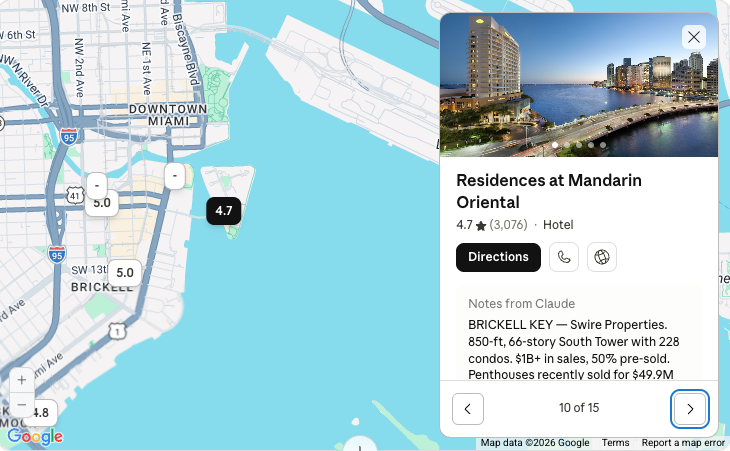
Third, the branded residence boom. International buyers from São Paulo, Lagos, Dubai, and Mumbai aren't shopping for condos — they're shopping for brands they trust. Cipriani. Mandarin Oriental. Dolce & Gabbana. Mercedes. Nobu. The branding lets developers charge 30-50% premiums over comparable unbranded product.
What it means
Brickell has split into two distinct development zones. East of Brickell Avenue, along the bay, the supertalls compete for global ultra-luxury buyers. West of the avenue, past the Metrorail, a denser cluster of mid-rise towers — One Twenty Brickell, Miami Starlite, 1 Southside Park — targets the rental and short-term-rental market.
Once Waldorf, 888 Brickell, and Citadel deliver, Brickell will have used most of its remaining height slots. The next wave won't be about height. It'll be about land scarcity, smaller floor plates, and density.
By 2030, the skyline you see today will be unrecognizable. Not just taller — denser, more brand-saturated, and economically reoriented from a sun-and-luxury market to a real financial center. If you want to see what a city looks like when capital, regulation, and timing all line up, keep your eye on Brickell.


