
Categories
Miami Community News, Investing in Real EstatePublished September 18, 2026
Palmetto Bay Data Center Ban: What It Means for Homeowners

What actually happened
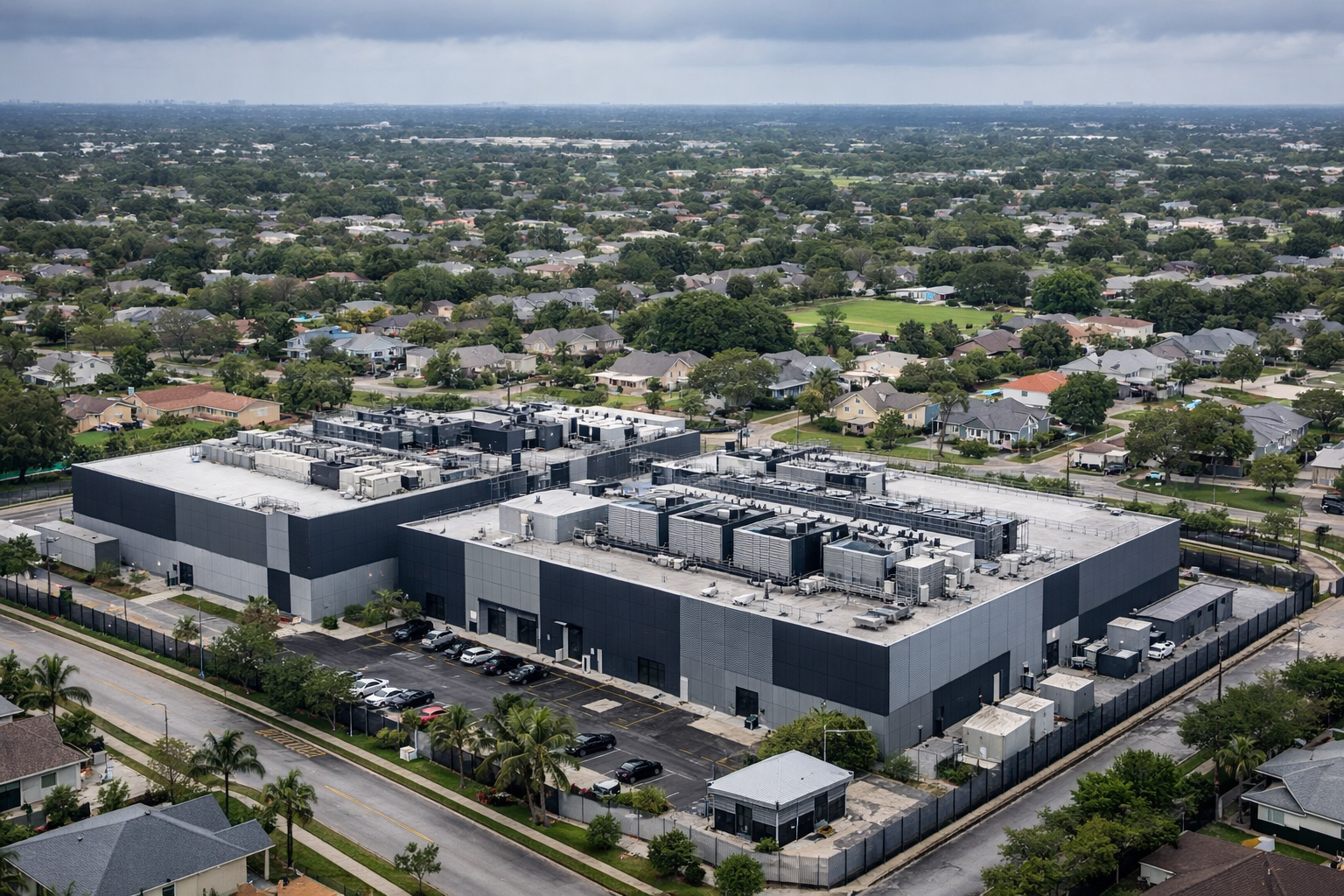
The Palmetto Bay council takes up the ordinance on September 28. Two things make it unusual. It's a permanent prohibition rather than the temporary moratoriums other Florida jurisdictions have reached for, and it arrives before anyone has filed anything, as the South Florida Business Journal reported.
The concerns driving it are the ones you'd expect from a village sitting on Biscayne Bay — water draw, discharge, and the industrial footprint of the buildings themselves. Merwitzer has pointed at the US-1 commercial corridor specifically, and at existing telecommunications infrastructure that could in theory be converted rather than built new.
This isn't happening in isolation. Florida has more than 100 data centers, roughly 27 of them in the Miami area, per Data Center Map. Palm Beach County is advancing a temporary freeze on large-scale applications. Leon, Nassau, Pasco, and Sarasota counties have already adopted moratoriums.
And in May 2026, Governor DeSantis signed SB 484, the Florida Hyperscale Data Center Act. It took effect July 1. Among other things, it bars utilities from passing large-load costs to residential ratepayers, and it explicitly preserves local government authority to reject a data center project. That last clause is why Palmetto Bay can do this at all. Before July, a village drafting a ban had to worry about state preemption. Now it doesn't.
Why this is a property question, not a tech story
Here's the part that matters if you own in South Miami-Dade.
In unincorporated Miami-Dade County, data centers aren't zoned as data centers. They fall under the county code's "telecommunications hub" classification, and they're permitted by right in industrial districts. Permitted by right means exactly what it sounds like — no rezoning application, no public hearing, no council vote.
And when a project doesn't require rezoning, county mailed notice only reaches owners within 500 feet. In an industrial district, 500 feet usually means other industrial parcels. The homeowners three blocks away get nothing.
That's how a project reaches construction before the people living near it know it exists. It has already happened in Miami-Dade, and it's the reason this became a municipal fight rather than a permitting fight.
Palmetto Bay is an incorporated municipality with its own zoning code. It can close that door for itself. The unincorporated pockets around it cannot — not unless the county moves on its own code.
So the honest read is this: a Palmetto Bay ban buys land-use certainty inside village limits and changes nothing one street outside them.
That distinction is worth real money in a market like this one. Palmetto Bay has been running around six months of inventory — a balanced market by any standard definition — with median days to contract in the low forties and single-family medians in the seven figures. Buyers at that price point do diligence. They pull surveys, they check flood zones, and increasingly they ask what the industrially zoned parcel on the other side of the treeline can legally become. A codified answer is easier to underwrite than a shrug.
I'd stop short of saying a ban raises values. That's a claim nobody can support, and the last thing this market needs is another agent making one. What I'll say is narrower and defensible: land-use certainty removes a discount risk. It doesn't create a premium — it takes an unknown off the table. In a balanced market where buyers have room to negotiate and sellers are weighing sequencing carefully, removing an unknown is not nothing.
There's a second-order piece too. Palmetto Bay's developable land is limited, and the ordinance is partly an argument about what the remaining commercial parcels along US-1 should hold. Rule that out for one use and the pressure moves elsewhere — likely further south and west, toward the unincorporated corridors and the municipalities that haven't taken a position. South Dade's pipeline has been busy on the residential side already, from approved homesites in Florida City to workforce projects in Princeton and Naranja. Industrial demand competing for the same shrinking supply of land is a real dynamic to watch over the next few quarters.
What to do about it
If you own in Palmetto Bay. The vote is September 28 and it's a public zoning meeting. If the outcome matters to you, that's where it gets decided — not on social media. Whichever way it goes, don't put it in your listing remarks. Marketing a property on a land-use outcome you can't guarantee is the kind of claim the Code of Ethics disfavors, and buyers' agents will check.
If you're buying in or near Palmetto Bay. Two questions belong in your inspection period. First: is this address inside village limits or in unincorporated Miami-Dade? People use "Palmetto Bay" loosely for a wider area than the village actually covers, and the jurisdiction determines which zoning code governs the parcel behind you. Second: what's the zoning on the adjacent and nearby parcels, and what's permitted by right there? Your title company can point you to the right county records, but the question has to come from you — it isn't on any standard disclosure.
If you own elsewhere in South Dade. Nothing in the Palmetto Bay ordinance touches you. If you're near an industrial district in unincorporated territory, the by-right pathway is still open, and the 500-foot notice radius is still the notice radius. That's an argument for checking neighboring zoning now rather than the week you decide to list.
If you're relocating here. Add this to the same column as insurance, flood zone, and association dues — the costs and unknowns that don't show up in the mortgage payment but shape what you actually own.
Frequently Asked Questions
Would the ban apply to my house if I live just outside Palmetto Bay?
No. A village ordinance only governs parcels inside village limits. If your address is in unincorporated Miami-Dade County, county zoning applies, and county code currently permits data centers by right in industrial districts under its telecommunications hub classification.
Are there already data centers in Miami-Dade?
Yes. Data Center Map counts roughly 27 in the Miami area and more than 100 statewide. Most are small, single-story facilities, not the hyperscale campuses driving the current debate. The opposition in Florida has focused on the large-scale projects, not the existing inventory.
Does state law let a Florida city ban data centers?
Yes. SB 484, signed in May 2026 and effective July 1, preserves local government authority to reject data center development and to impose stricter standards than the state's. It also defines facilities drawing 50 megawatts or more at peak as large-scale and bars utilities from passing their costs to residential and small-business ratepayers.
How would I find out if something like this were proposed near a home I'm buying?
Don't rely on being notified. When a project doesn't require rezoning, mailed notice in Miami-Dade only goes to owners within 500 feet, which in an industrial district often means no residential owners at all. Check the zoning and permitted uses on nearby parcels during your inspection period, before your contingencies expire.
The short version: Palmetto Bay is trying to answer a land-use question before it becomes a land-use problem, and the answer will only bind inside village limits. Whether that helps or hurts your position depends entirely on which side of the line your address sits on and what's zoned behind you.
If you own here or you're looking in South Dade and want to know what that actually means for your specific parcel and your timeline, I'm glad to pull it apart with you — you can grab a time here.
About Pedro Casanova
Pedro Casanova is a real estate broker that leads The KREN Group real estate team serving the Southeast Florida area. They specialize in helping people build wealth through real estate by helping buyers and sellers maximize their opportunity in every transaction. Connect with the team at www.thekrengroup.com.
The KREN Group | Keller Williams Premier Properties
Pedro Casanova
| The KREN Group | Keller Williams Premier Properties | PLACE
or another way