Published December 17, 2025
University of Miami’s $7M Burger King Purchase Signals a Major Pinecrest Transformation

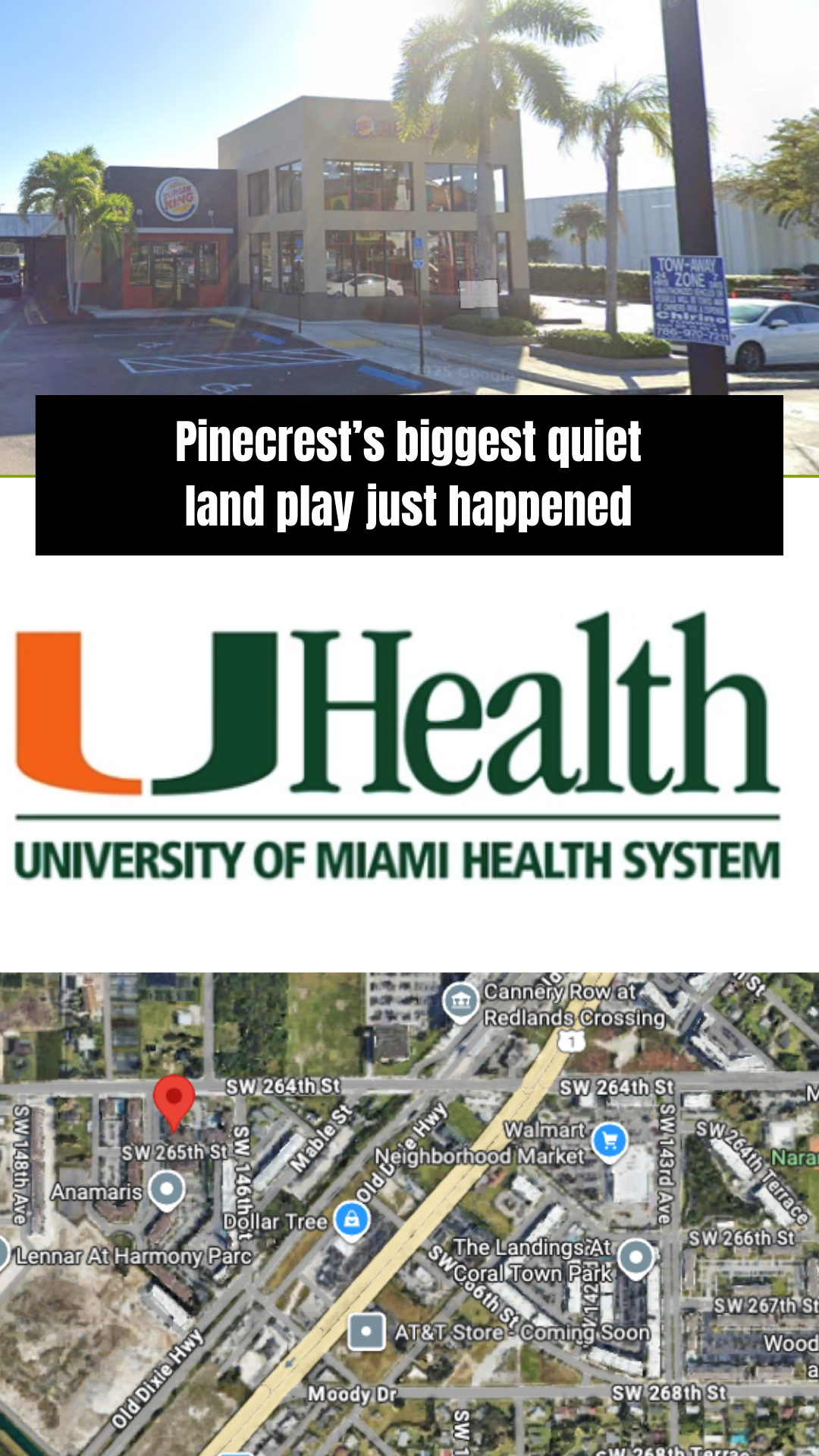
University of Miami’s $7M Burger King Purchase Signals a Major Pinecrest Transformation
Miami real estate isn’t just shaped by developers—it’s increasingly driven by institutions. A perfect example just unfolded in Pinecrest, where the University of Miami quietly paid $7 million for a Burger King property along South Dixie Highway.
At first glance, buying a fast-food restaurant might seem odd. But this transaction is a strategic land play that reveals UM’s long-term vision for healthcare expansion in South Miami-Dade.
Why the Burger King Matters
The 32,670-square-foot Burger King site at 13201 S. Dixie Highway directly adjoins a 4.6-acre property UM purchased from Macy’s in 2024. That former furniture store has since closed, and the combined land assemblage now creates the footprint for a massive new medical facility.
According to UHealth leadership, the Pinecrest site is planned to become a 125,000-square-foot ambulatory care center. The project is expected to include services from the Sylvester Comprehensive Care Center, Bascom Palmer Eye Institute, Desai Sethi Urology Institute, and sports medicine.
In other words, this isn’t just a clinic—it’s a full-scale medical destination.
A Strategic Real Estate Clause
One of the most telling details in the deed is a restriction preventing the property from ever being sold or leased to another quick-service restaurant. That clause highlights UM’s intent: permanent land control and protection of the medical campus environment.
This is a classic institutional real estate strategy—eliminate incompatible uses, control surrounding parcels, and future-proof the investment.
Part of a Larger UHealth Expansion
This Pinecrest move follows a broader pattern. In recent years, UHealth has opened major ambulatory care centers in Doral and North Miami, strategically placing medical hubs near population centers and major roadways.
Pinecrest, with its affluent residential base and proximity to US-1, fits perfectly into that expansion model.
What This Means for Pinecrest Real Estate
Institutional buyers like the University of Miami bring stability, long-term investment, and increased property values to surrounding areas. Medical anchors also attract complementary development, from professional offices to residential demand driven by healthcare employment.
While village officials have not yet confirmed filed development plans, all signs point to Pinecrest becoming the next major node in Miami’s evolving healthcare real estate landscape.
Final Takeaway
The $7 million Burger King purchase isn’t about burgers—it’s about vision. It shows how Miami’s most powerful institutions quietly reshape neighborhoods, one parcel at a time.
In Miami real estate, the biggest moves aren’t always the loudest—but they’re always strategic.