
Published May 15, 2026
What’s Next for Spirit Airlines’ Newly Built Headquarters in South Florida?

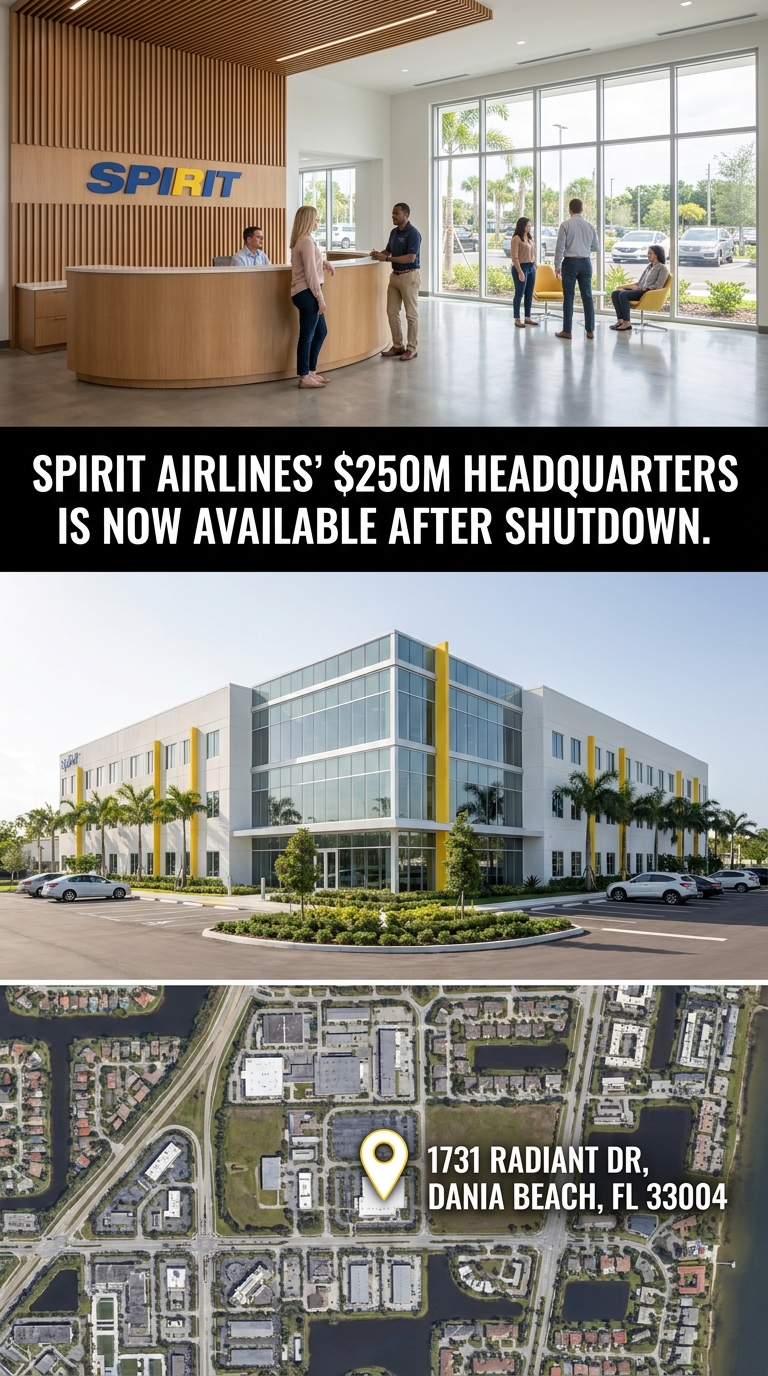
What’s Next for Spirit Airlines’ Newly Built Headquarters in South Florida?
South Florida’s corporate real estate market just gained one of its most unexpected vacancies. Following the collapse of Spirit Airlines, attention is now turning to the company’s newly developed headquarters campus in Dania Beach — a modern office property that was once seen as a symbol of the airline’s long-term commitment to South Florida.
Now, with the ultra-low-cost carrier officially winding down operations, questions are growing around what happens next to the massive corporate space and what it could mean for Broward County’s office and real estate markets.
Spirit’s Headquarters Was Built for Growth
Spirit Airlines spent years developing its “Spirit Central” headquarters near Fort Lauderdale-Hollywood International Airport. The sleek campus featured collaborative office spaces, employee amenities, training facilities, and operational centers designed to support thousands of workers.
At the time, the project represented confidence in South Florida’s growing role as a business and aviation hub. Dania Beach and the surrounding airport corridor had become increasingly attractive for corporate relocations thanks to Florida’s tax advantages, expanding infrastructure, and international connectivity.
But the airline industry shifted dramatically after rising fuel costs, mounting debt, and failed restructuring efforts ultimately forced Spirit to cease operations in May 2026.
The closure affected approximately 17,000 employees nationwide and left a major vacancy in one of Broward County’s most strategically positioned office locations.
Why the Property Could Still Be Highly Valuable
Even with Spirit gone, the headquarters itself remains a highly attractive asset.
The campus sits near Fort Lauderdale-Hollywood International Airport, one of the busiest airports in Florida and a critical gateway for both domestic and international travel. The surrounding area has continued seeing major commercial and residential growth over the past several years as companies look beyond Miami’s rising office costs.
Because the building was purpose-built for aviation operations, potential future tenants could include:
- Airlines or aviation service companies
- Logistics and transportation firms
- Technology companies
- Corporate relocation tenants
- Government or infrastructure agencies
South Florida’s continued population growth and business migration trends may also help soften the impact of Spirit’s departure over time.
A Bigger Story About South Florida Real Estate
Spirit’s collapse also highlights how quickly South Florida’s commercial landscape is evolving.
Over the last decade, the region became a magnet for corporate expansion, fueled by remote work migration, favorable taxes, and international investment. Companies from New York, California, and Latin America increasingly viewed Miami-Dade and Broward Counties as long-term business hubs.
But large corporate campuses can become vulnerable when tied too closely to a single industry.
Now, brokers, investors, and developers will likely watch closely to see whether Spirit’s former headquarters becomes repositioned, partially leased, or redeveloped entirely.
What Happens Next?
While no final redevelopment plans have been publicly announced, the property’s location alone gives it strong long-term potential. South Florida office inventory near major airports remains limited, especially for newer Class A facilities with modern infrastructure.
As airlines reshape routes following Spirit’s shutdown and other carriers expand throughout Fort Lauderdale, the area surrounding the former headquarters may continue evolving into a larger transportation and business corridor.
For South Florida real estate, the story is no longer just about Spirit Airlines. It’s about how one of the region’s fastest-growing markets adapts when a major corporate player suddenly disappears.


