
Categories
Pricing Strategy, Selling a Home, Staging and PrepPublished November 24, 2026
No Offers on Your Miami-Dade Home? Cut the Price or Wait?

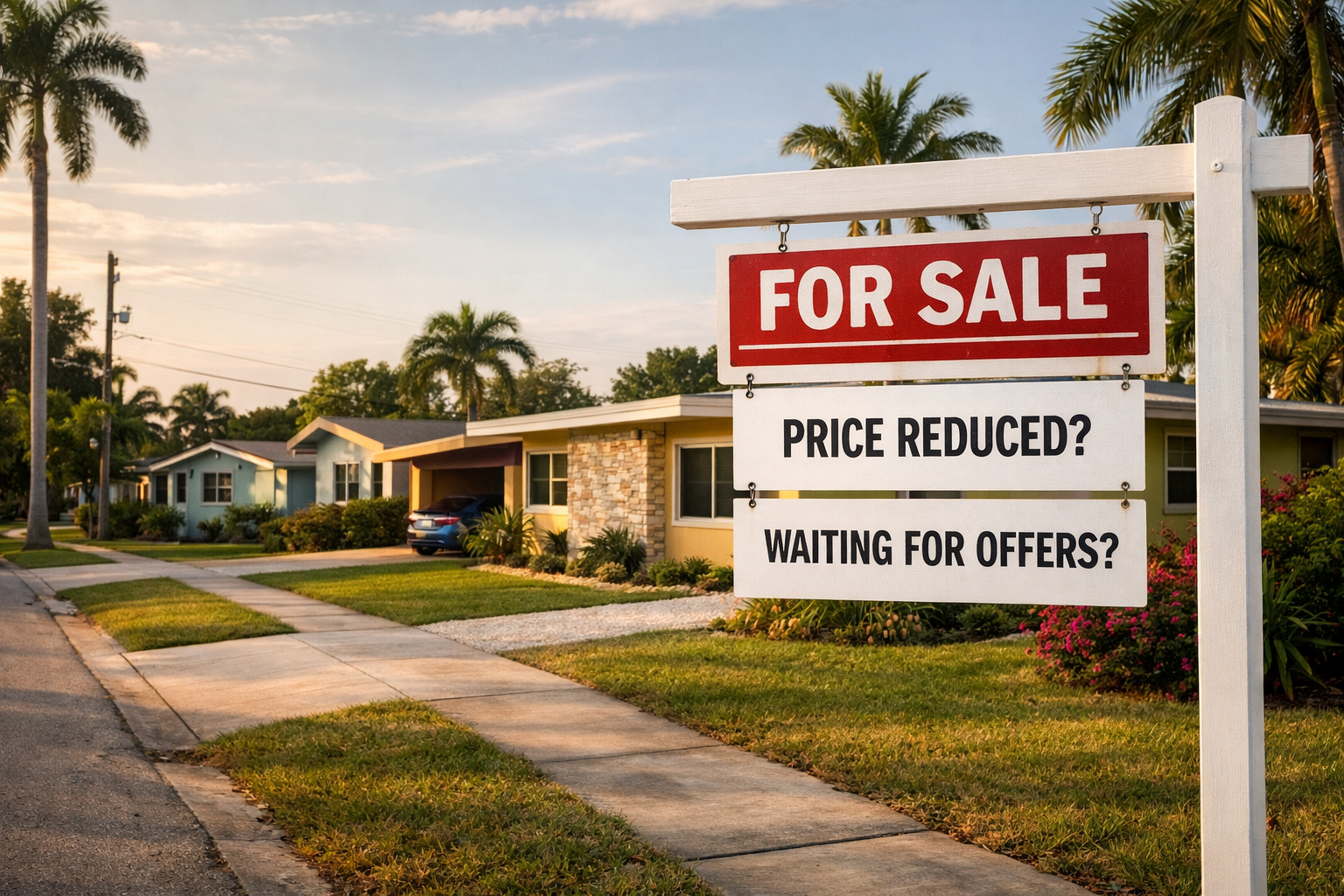
Should you cut the price on a Miami-Dade home with no offers?
If your house has had showings but no offers, a price cut of roughly 3% is the standard move, and it works best early — in the first three to four weeks, not the tenth. If it has had almost no showings at all, fix the photos, the listing, and the price position first. Waiting rarely helps: in October 2026, Miami-Dade single-family homes that closed did so in a median of 42 days, and 36% of them had already cut the price at least once.
By Pedro Casanova | November 9, 2026
Nobody lists a house hoping to cut the price. But when the first few weeks pass and your phone isn't ringing, the question lands hard: do you hold your number, or do you move it? Here's how I walk sellers through that decision.
What the Miami-Dade market is telling you right now
Start with the benchmark, because your listing is being compared to it whether you like it or not. According to PBP Real Estate's October 2026 Miami-Dade report (BeachesMLS data, as of November 8):
- Single-family: $710,000 median sale price, 6.1 months of inventory, 42 median days on market, about 4,759 homes for sale.
- Condos and townhouses: $399,500 median, 13.5 months of inventory, 70 median days on market, about 12,461 for sale.
- Price cuts are normal: 41.3% of active single-family listings are priced below their original list price, and 36% of October single-family closings (44% of condo closings) had at least one cut before the buyer signed.
Realtor.com data on FRED shows the same pressure from the supply side: active listings in Miami-Dade stood at 17,010 in September 2026, and the count of listings with a price reduction rose to 3,074 from 2,776 in August. On the demand side, Freddie Mac's 30-year fixed rate averaged 7.18% the week of November 5, 2026 — better than last week's 7.24%, but well above the 6.22% buyers saw a year ago.
What that means for you: a 6-month single-family market is balanced-to-slightly-buyer-leaning, and a 13-month condo market is firmly a buyer's market. If you're pricing off what your neighbor got in 2024 or a Zestimate, the market has probably moved past that number.
Read your own listing before you touch the price
A price cut fixes a price problem. It doesn't fix a presentation problem, and the two look similar from the outside. Check these in order:
- Showings in the first 14 days. Few or none? Buyers are scrolling past you. Look at the photos, the first 150 characters of the description, and whether the price sits just above a search filter break (for example, $725,000 when buyers filter at $700,000).
- Showings but no second showings. People are coming through and leaving. That's usually condition, smell, clutter, or a price that looks high once they've seen the inside.
- Showings, second showings, but low or no offers. The market has put a number on your house, and it's lower than yours. This is the clearest price signal you'll get.
- Offers that arrive but fall apart. That's a different problem — often inspection, insurance, or financing — and a price cut won't solve it.
Ask your agent for showing counts and written buyer feedback every week. Not a summary — the actual comments. This is exactly the data I pull for my sellers before we decide anything.
The math: a cut costs less than waiting
Say you listed at $850,000. The median price reduction on South Florida listings this year has been about 3.1% according to Zillow data reported by NBC 6 in June, so use that as a reference point.
- A 3.1% cut is $26,350, bringing you to $823,650.
- For a buyer putting 20% down at 7.18%, that cut lowers the monthly principal-and-interest payment by roughly $143. With 5% down, it's about $170. That's small — which is why a tiny $5,000 cut rarely moves buyers and a cut that crosses a search threshold often does.
- It also lowers your documentary stamp tax on the deed by about $158 at $0.60 per $100 in Miami-Dade, and your commission base along with it.
Now the cost of waiting. If your carrying costs — mortgage, property tax, insurance, utilities, and upkeep — run $4,200 a month (hypothetical, yours will differ), every two months of sitting costs $8,400 before you've changed anything. And a listing that's been up 70 days reads as stale to buyers, so the cut you eventually take often has to be bigger than the one you'd have taken on day 21.
None of this means you must cut. If you can afford to wait and your house is genuinely unique, holding firm is a legitimate choice. But make it a decision with a date on it, not a drift.
Alternatives to a straight price cut
A cut isn't your only lever. Each trades off differently:
- Buyer closing-cost credit. A 2% credit on $850,000 is $17,000. It keeps the recorded price (and your comps) higher, which can help the appraisal, but it doesn't reduce the monthly payment the way a lower price does unless the buyer uses it for a rate buydown. Ask your lender how that would work in their situation.
- Targeted fixes. If feedback keeps repeating — the same dated bathroom, the same smell, the same landscaping complaint — fixing it can be worth more than 1% off. If the roof or insurability is the objection, price the fix or a credit into your plan.
- Timing the cut. A single decisive reduction beats three small ones. Each small cut tells buyers you're still negotiable and keeps them waiting for the next.
- Condo sellers: with 13.5 months of supply, expect to be priced against the lowest comparable unit in your building. Check pending special assessments too — our guide to selling a Miami-Dade condo before the special assessment explains how those can change your buyer pool overnight.
- Selling before you buy: if your timeline depends on a purchase, the price cut question is tied to that deadline. Our post on whether to sell first or buy first when moving up covers how to coordinate.
How I decide with sellers
I won't tell you a number without your comps in front of me, because the right cut depends on your street, your condition, and your deadline. What I do is lay out three things: what comparable homes actually sold for in the last 60–90 days, what's currently active and competing with you, and what your showing feedback says. Then we set a decision date — typically around day 21 to 28 — and a price we both agree on before the feedback comes in, so emotion doesn't make the call.
Frequently Asked Questions
How much should I drop my price in Miami-Dade if there are no offers?
A typical reduction is around 3%, based on Zillow data for South Florida reported in June 2026. The right number depends on your comps and showing activity, and a cut that crosses a common search price threshold usually does more than a smaller one.
How long should a house sit on the market in Miami-Dade before changing the price?
October 2026 single-family sales had a median of 42 days on market, and condos 70 days. If you've had showings but no offers by around day 21 to 28, that's the window to reassess, rather than waiting for the median to pass.
Is it better to cut the price or offer a buyer credit?
A price cut lowers the buyer's payment and your doc stamps; a credit keeps the recorded price higher and helps with closing costs. Which one works better depends on the buyer's financing and your comps, so run both with your agent and lender.
Should I take my house off the market if it isn't selling?
Pulling it can make sense if you need time to make repairs or the season is wrong for your property. But the days-on-market clock and your carrying costs are real, so take it off with a plan and a relist date, not as a way to avoid the pricing question.
Next step
If your listing is sitting and you want an honest read on whether it's the price, the presentation, or the market, I'm happy to look at your numbers. I offer a free buying or selling strategy session — no pressure, just a straight conversation about where you stand and what your options are. You can grab a time here.
About Pedro Casanova
Pedro Casanova is a real estate broker that leads The KREN Group real estate team serving the Southeast Florida area. They specialize in helping people build wealth through real estate by helping buyers and sellers maximize their opportunity in every transaction. Connect with the team at www.thekrengroup.com.
The KREN Group | Keller Williams Premier Properties

Pedro Casanova
| The KREN Group | Keller Williams Premier Properties | PLACE
or another way